Guno Türkçe

Dream reading · iOS

What did
last night say?
42 minds will tell you.

Two sentences is enough. Jung hears a shadow, the folk tradition hears a warning, your future self hears a decision you already made. Same dream, four different answers — and you can keep talking to any of them.

No sign-up, no email English · Türkçe · Español · Português Answers in the language you wrote in
See a real reading

Coming to the App Store soon.

Guno

Real output

One dream, four readings.

Everything below came out of the app itself — not a line of it was written to look good here. We gave the same dream to four voices and each one took hold of a different corner.

The dream

I was walking through a house I had never seen, but I knew it was mine. Every room had a clock and none of them showed the same time. In the last room someone was waiting for me, and I could not see their face.

J

Jung

Psychology · 25 credits

This is a house that belongs to you, but only at night; it holds rooms the daylight self has not explored. The psyche chooses these uncanny interiors when waking life is lived by routine and the clocks all agree too easily. Here, the ground of the dream is not certainty, but dissonance: every clock ticks to its own tempo, refusing to let you settle into a single, agreed-upon hour.

What is the dream correcting? Perhaps your days have become tightly scheduled, life arranged around external time, the calendar, the next appointment. The house offers you a kind of inner multiplicity instead: room after room, each with its own clock, each insisting that time is not a single stream but a web of possibilities. In myth, the many clocks echo the world of faerie, where time slips sideways, or the underworld journeys of Orpheus and Persephone, where time obeys different laws. The dream seems to ask: whose time have you been living by, and who sets the hour in your own house?

Now, the faceless figure waiting in the last room — the stranger at the heart of the labyrinth. There is an unmistakable charge here, a sense that this is both a meeting and a revelation withheld. The facelessness is important: in dreams, it often signals a part of ourselves not yet made conscious, a presence felt but not seen. This figure is both familiar and unknown, a visitor who belongs here as much as you do. In folklore, the stranger in the house can be a spirit, a shadow, sometimes even the Self — the greater personality that waits behind the mask of daily identity.

Ask yourself: what quality belongs to this faceless one that is lacking in your waking life? Is it patience, mystery, authority, or simply the freedom not to be named? Sometimes the figures we cannot bear to face carry the very qualities we have pressed out of view. The personal layer: perhaps you sense that there is a decision coming, or an aspect of your life left unacknowledged, waiting in the last room for your arrival. The collective layer: the faceless one is every unknown future, every unlived part, every possibility you have not yet dared to meet.

It is tempting to try and force the clocks to agree, to bring order to the house by daylight rules. But this dream lets each room keep its own hour, and holds the mystery of the stranger intact. The house is yours, but it is wider than your current map of yourself.

If you could look the faceless figure in the eyes, what do you imagine they would want from you?
The conversation

A reading that answers back.

When the reading ends the conversation starts. The voice remembers what it told you and what you wrote, so two nights later you can come back with “I had it again” and pick up where you left off.

I had this dream again last night. What might have changed?
JungThe return of this dream suggests the question it raises has deepened or remained unresolved. The house and its many clocks persist, as does the faceless figure waiting in the last room—perhaps now more insistent, like a threshold you have circled but not crossed. Repetition often means the psyche is urging you to look closer, to sit longer with the unknown it offers.
I don't understand why I'm afraid to walk into that last room.
JungFear of that final room may be the fear of encountering a part of yourself not yet familiar or fully accepted—the unknown within your own house. The faceless figure waits there, both a stranger and a reflection, and the hesitation to enter is the hesitation to meet what resists being named or controlled. It is the shadow’s quiet summons: the invitation to know what you avoid or don’t yet recognize.
Guno

Three steps

Two minutes, before coffee.

No title, no tags, no date. Every extra field is a reason to close the app at seven in the morning.

1

Write the dream

Or say it out loud and let the app type it. Two sentences is plenty; the voice does the rest.

2

Pick a voice

42 readers, from philosophy to folklore. Each has its own eye, its own language, its own stubbornness.

3

Keep talking

If the reading landed, open the conversation. The voice remembers — even weeks later.

The catalogue

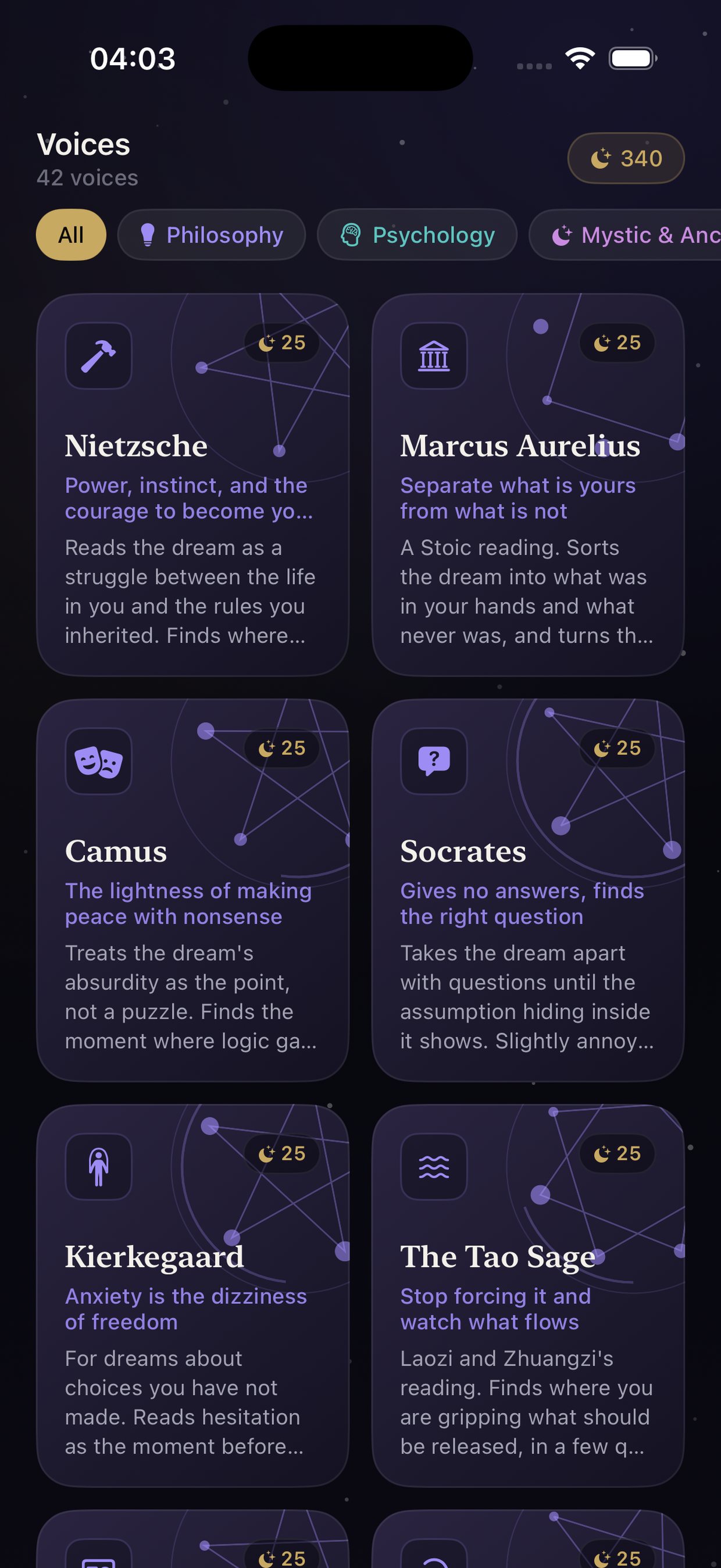
42 voices, six ways of thinking.

They all look at the same dream and none of them says the same thing. One is free every morning.

Philosophy

Old questions, asked about last night
  • Nietzsche
  • Marcus Aurelius
  • Camus
  • Socrates
  • Kierkegaard
  • +3
8 voices

Psychology

What the mind does with the day
  • Jung
  • Freud
  • Adler
  • The Empty Chair
  • The Bond Reader
  • +4
9 voices

Mystic & Ancient

Symbols older than psychology
  • The Nile Dream-Priest
  • The Animal Guide
  • The Path of the Heart
  • The Alchemist
  • The Card Reader
  • +3
8 voices

Tradition & Folklore

How families read dreams
  • Grandmother
  • The Ancient Dream Book
  • The Zhou Dream Manual
  • The Storyteller
  • The Myth Keeper
  • +1
6 voices

Science & Reality

Sleep, memory, and no mysticism
  • The Sleep Scientist
  • The Hard Realist
  • The Evolutionary Reader
  • The Lucid Coach
4 voices

Modern & Playful

Today's language, sharp aim
  • The Poet
  • The Group Chat Oracle
  • The Simulation Analyst
  • The Stand-Up
  • The Script Doctor
  • +2
7 voices

The app

Built for the dark.

Quiet, dim, nothing flashing. An app you open before your eyes have adjusted should not shout.

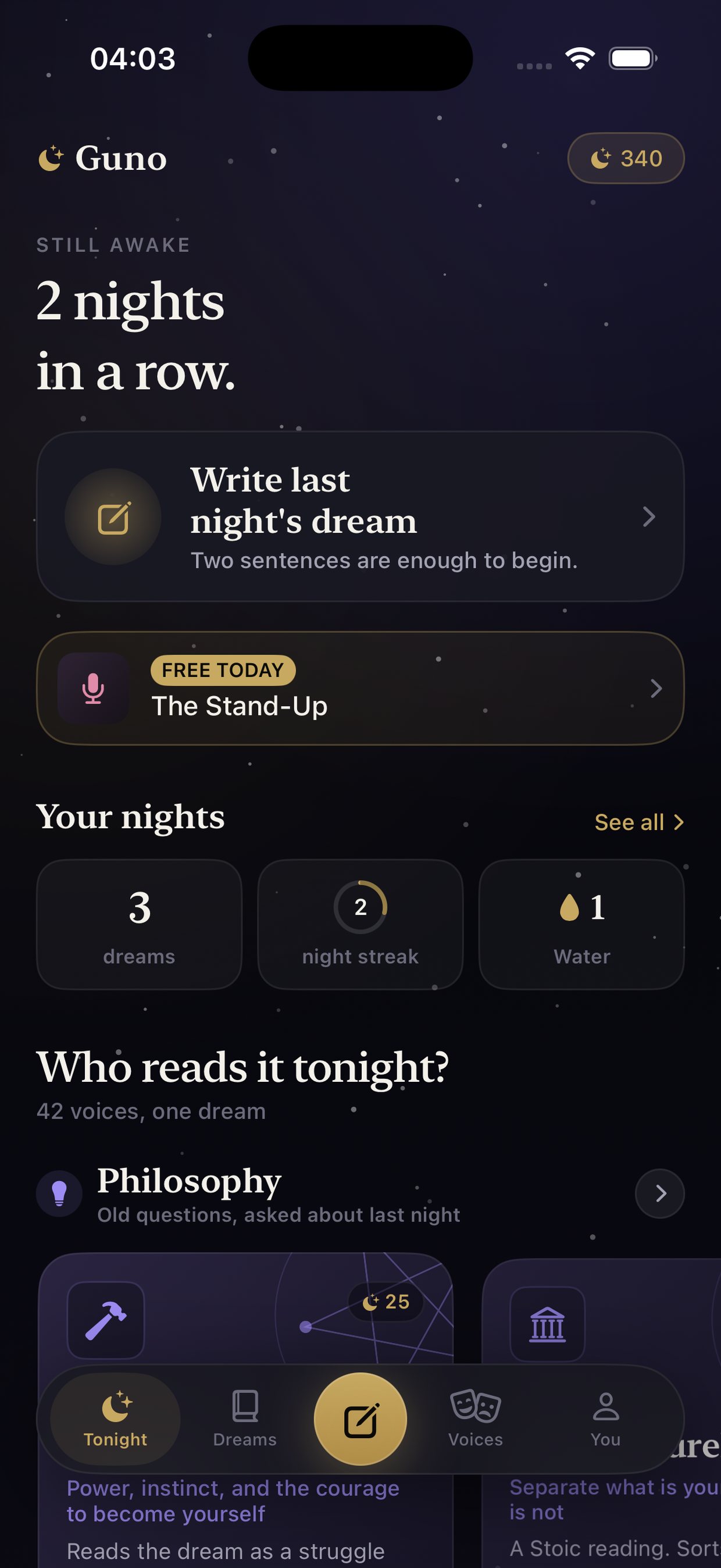
Tonight

Tonight: the free voice of the day and where you left off.

Voices

Voices: 42 readers by category, each one introducing itself.

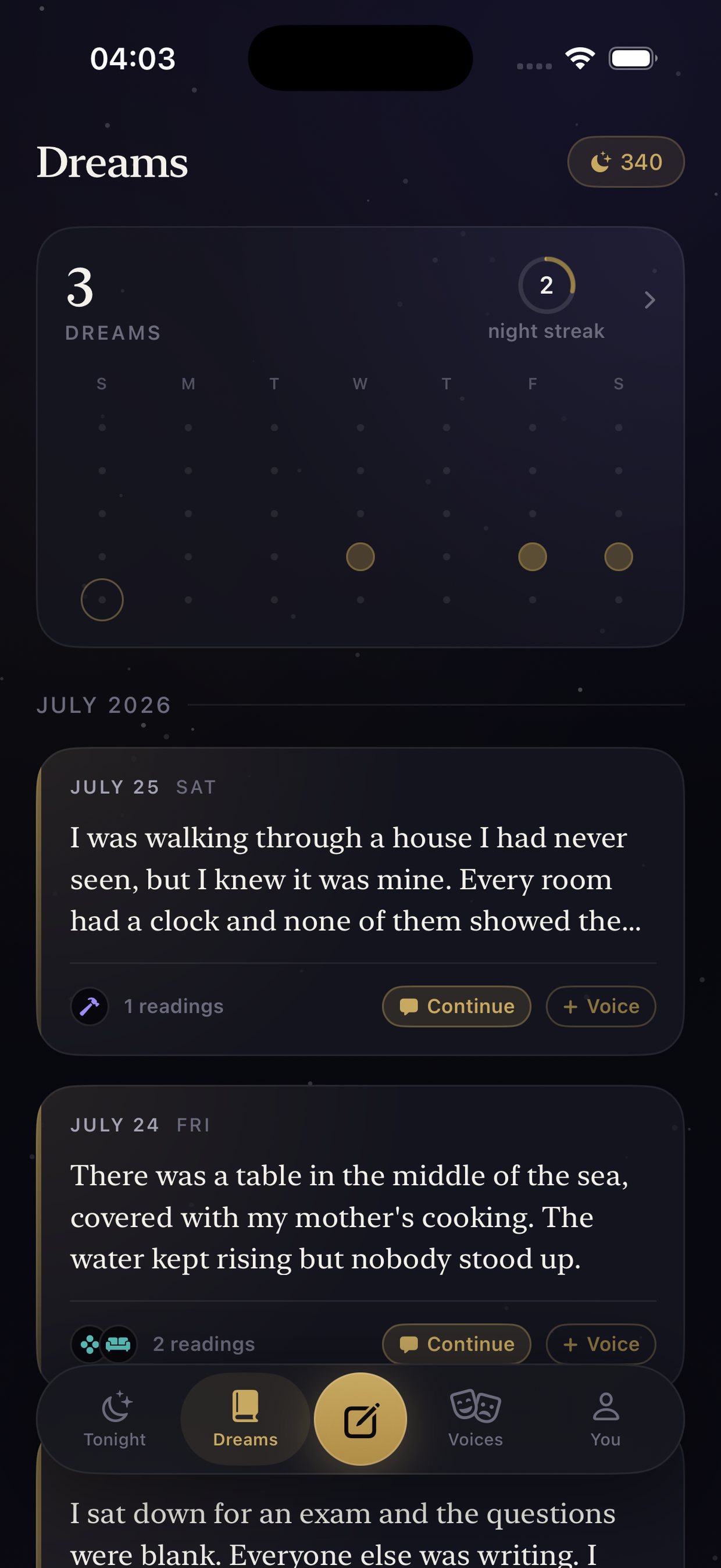
Dreams

Dreams: every night you wrote and every reading you got.

Before anything else

Guno is for entertainment and personal reflection only. The readings are written by AI. They are not medical, psychological, legal, financial or religious advice, and they do not predict anything.

There is no sign-up: no name, no email, no phone number. Your dreams are stored under a random device id and one tap deletes all of it. Nothing you write is used to train AI models.

If a dream turns heavy, the app stops interpreting and shows support lines instead — and no credits are spent.

The voices are characters written in the spirit of schools of thought and of thinkers who are no longer living. They are not those people and are not connected to their estates.